
Note: All data is mock and does not represent real production figures. Confidential details have been removed.
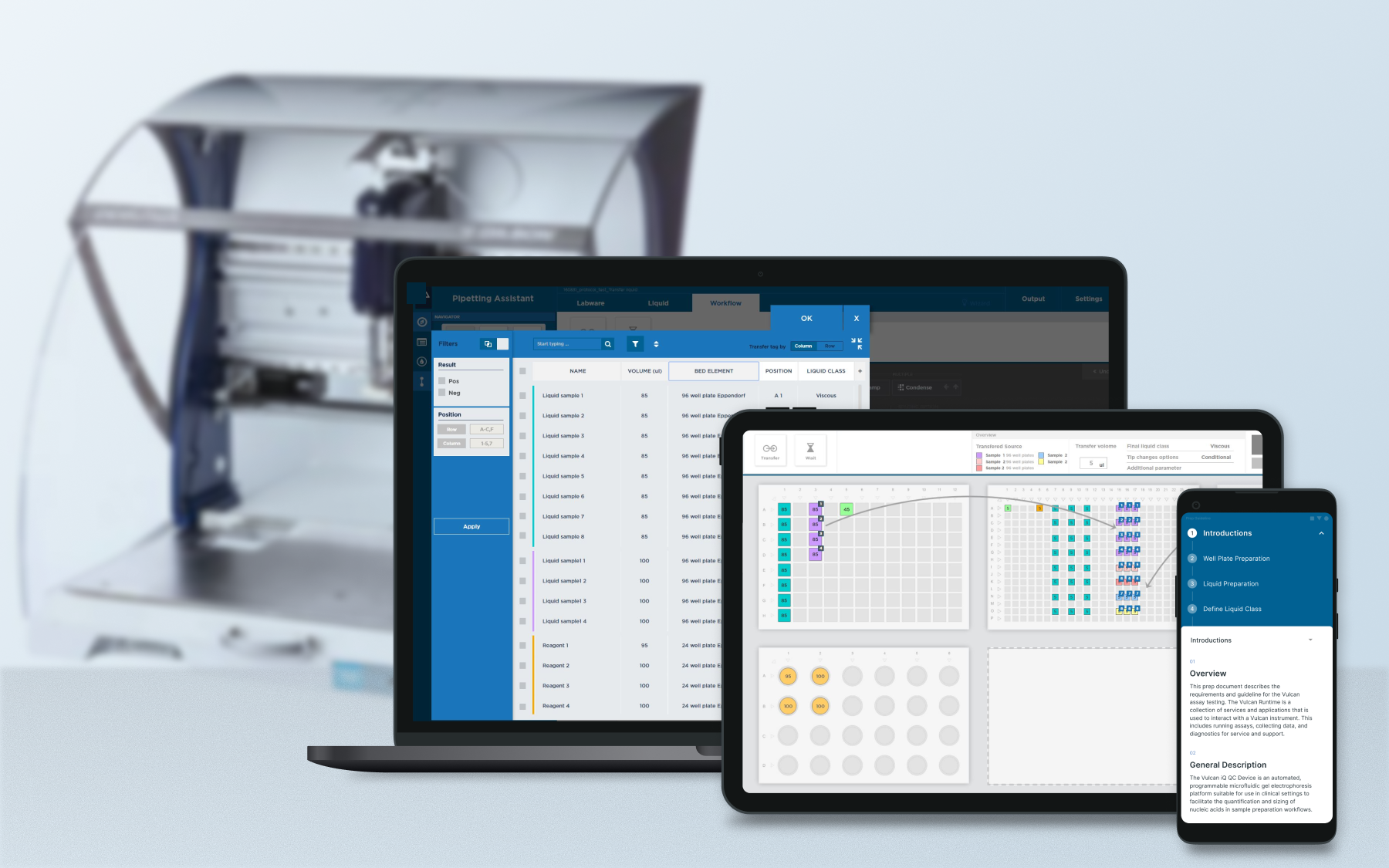
Lab-tech Client Project
Automated Workflow:
Pipetting Assistant
Product Format: Cloud-based Web (POC design)
Project Year: 2015
Client: Confidential
Summary
To build a state-of-the-art protocol builder, we designed a proof of concept that shortens the learning curve and feels intuitive along the building workflow for the lab instrument manufacturing client.
Challenges:
among the pipetting building workflow, by covering key steps: setting up liquids and labware, defining protocol steps, and reviewing the bed layout.
Solution:
A free-canvas interaction UX approach allowed users to explore features freely, with intuitive visual sample setting simulation for approachable and adaptable to individual needs.
Business impact:
⏱️ Protocol setup time was reduced by 30%
⭐️ User satisfaction improved from 3.7 (legacy app) to 6.4 out of 7.0
😎 95% of users reported feeling confident using the tool
Client: Global lab instruments manufacturer
Company: Indeed Innovation GmbH
Team: Myself (UX UI Design & Project Lead), 2 Software Developers, 1 Knowledge experts
Key Responsibilities:
- Project proposal and scoping
- Design strategy & User research
- UI prototyping & user testing
- Client management
- Background & Goal
The client, a U.S.-based manufacturer known for precision lab instruments, aimed to develop a state-of-the-art protocol builder software. The mission was to dramatically reduce the learning curve and streamline the process of pipetting protocol creation, making it intuitive, efficient, and cloud-ready for use across desktop and mobile devices.
“ How can we create state-of-the-art protocol builder software that shortens the learning curve and is as easy to use as possible?
- Getting to know the Lab
A laboratory was a new world to me, and it was essential to understand how this world is operating and who are engaged to this entire workflow and what are the underlying challenges and motivation.
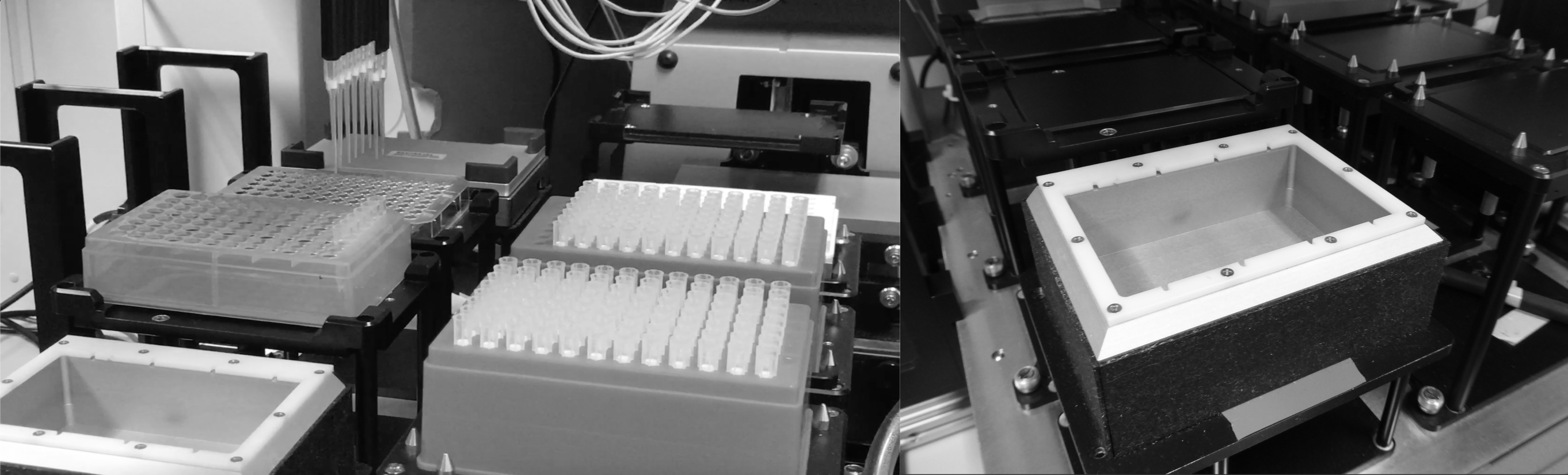
A. Field Research: Environment-Tool-Stakeholder Map
To gain firsthand insight, I spent a full week embedded in a working lab, observing workflows and shadowing scientists, engineers, and supervisors. I mapped the complete user journey, from equipment delivery and onboarding to independent use.
What stood out:
“The legacy native app is highly-regulating the pipetting workflow and not intuitive so needed 7-day technician’s onboarding.”
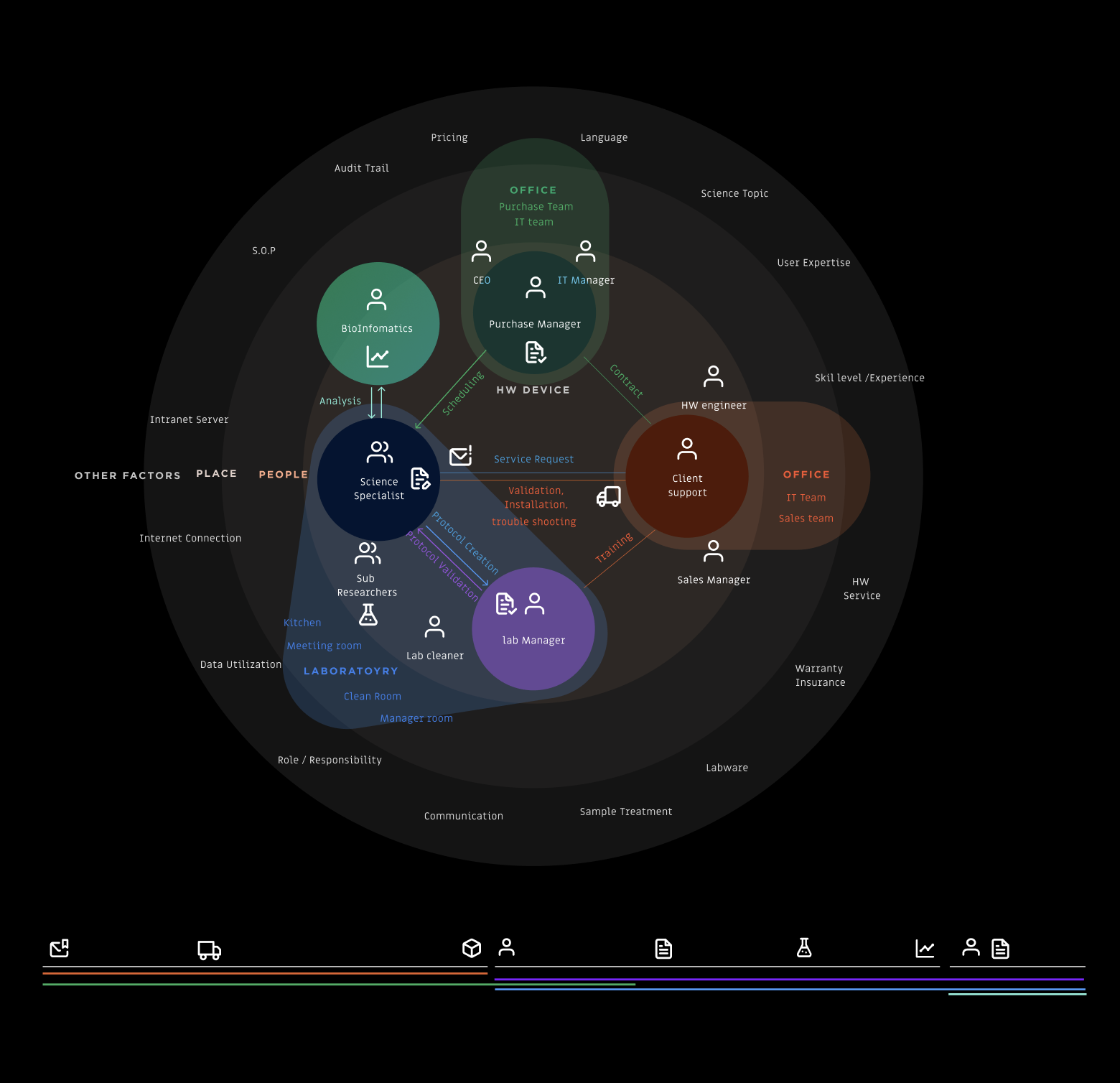
We identified several key bottlenecks in the protocol creation process prior to operating the pipetting machine:
- Setting up liquids and labware
- Creating workflow steps
- Reviewing the bed layout and settings
These pain points helped define the MVP and shape the design scope and delivery plan. To broaden our perspective, we proposed exploring multiple UX directions through wireframing. This led to defining the high-level software concept and prototyping detailed interactions. The high-fidelity mockups were then tested with users, validated through feedback, and iterated accordingly.

- Wireframing: Two UX Models
To define UX direction, we proposed two concepts with different workflow styles:
A. Linear workflow (Guided workflow)
- A step-by-step guide, structured and easy to follow
- Focusing on each task with a full screen and contextual menus while being able to navigate to the next step.
B. Free-Canvas (Enabling dynamic workflow)
- An open canvas style with drag-and-drop interaction, more flexible, but less prescriptive.
- Allowing users to explore different features and steps which enables full customisation of protocol creation.
✨ Testing Result: B. Free-Canvas Style
Based on user testing, the concept B, the free-canvas style was clearly preferred. Users appreciated it for several reasons:
- It offered more clarity and control, especially when customizing complex experiments.
- The drag-and-drop interaction felt intuitive and even slightly gamified, which made the experience more engaging and increased their motivation to use the software.
“This is one of the first signs that scientific software could embrace more creative, non-linear interaction models.”

- POC design development: Germany <-> Slovenia Collaboration
How could collaboration look like without virtual tools (Miro / Figma)?
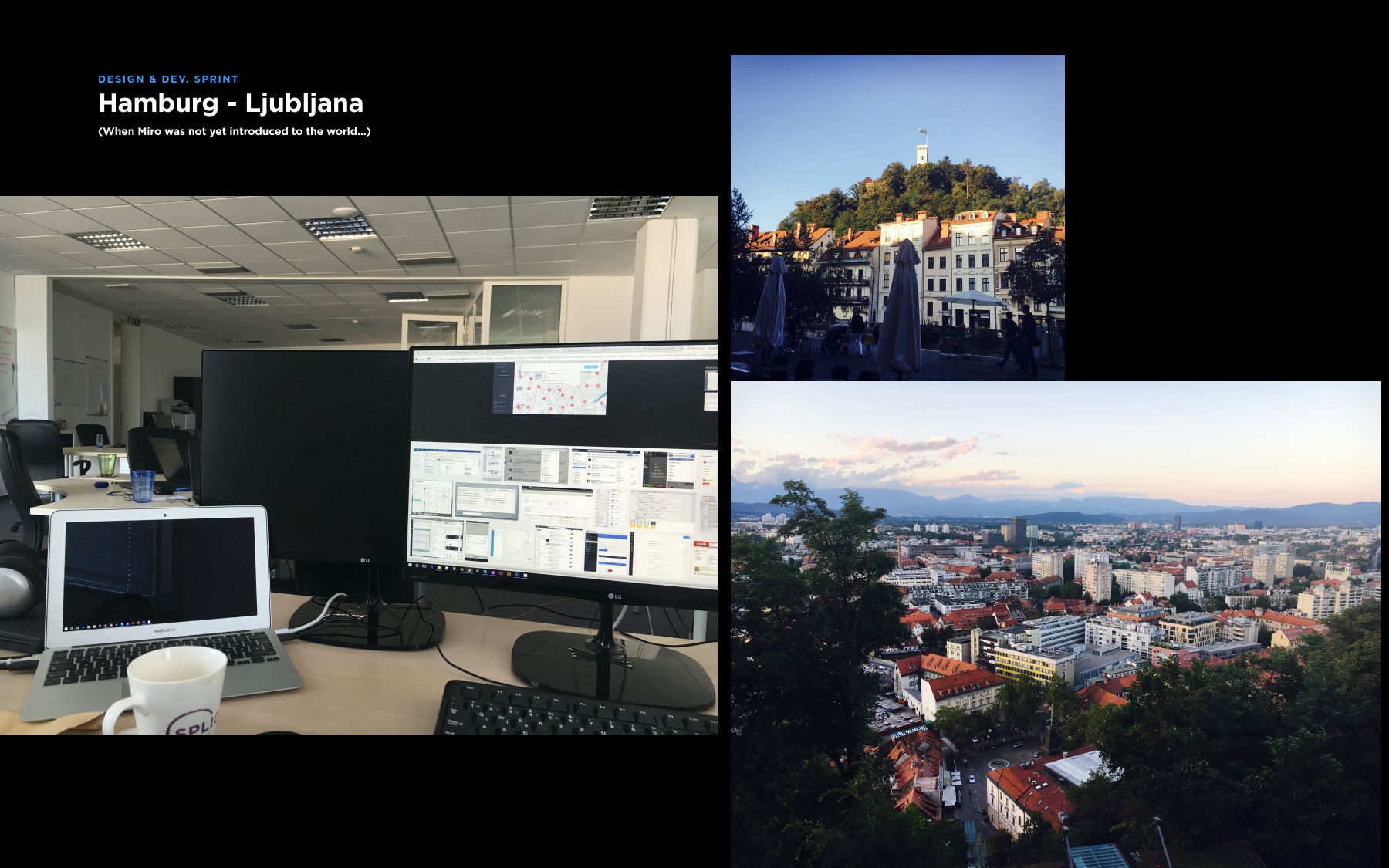
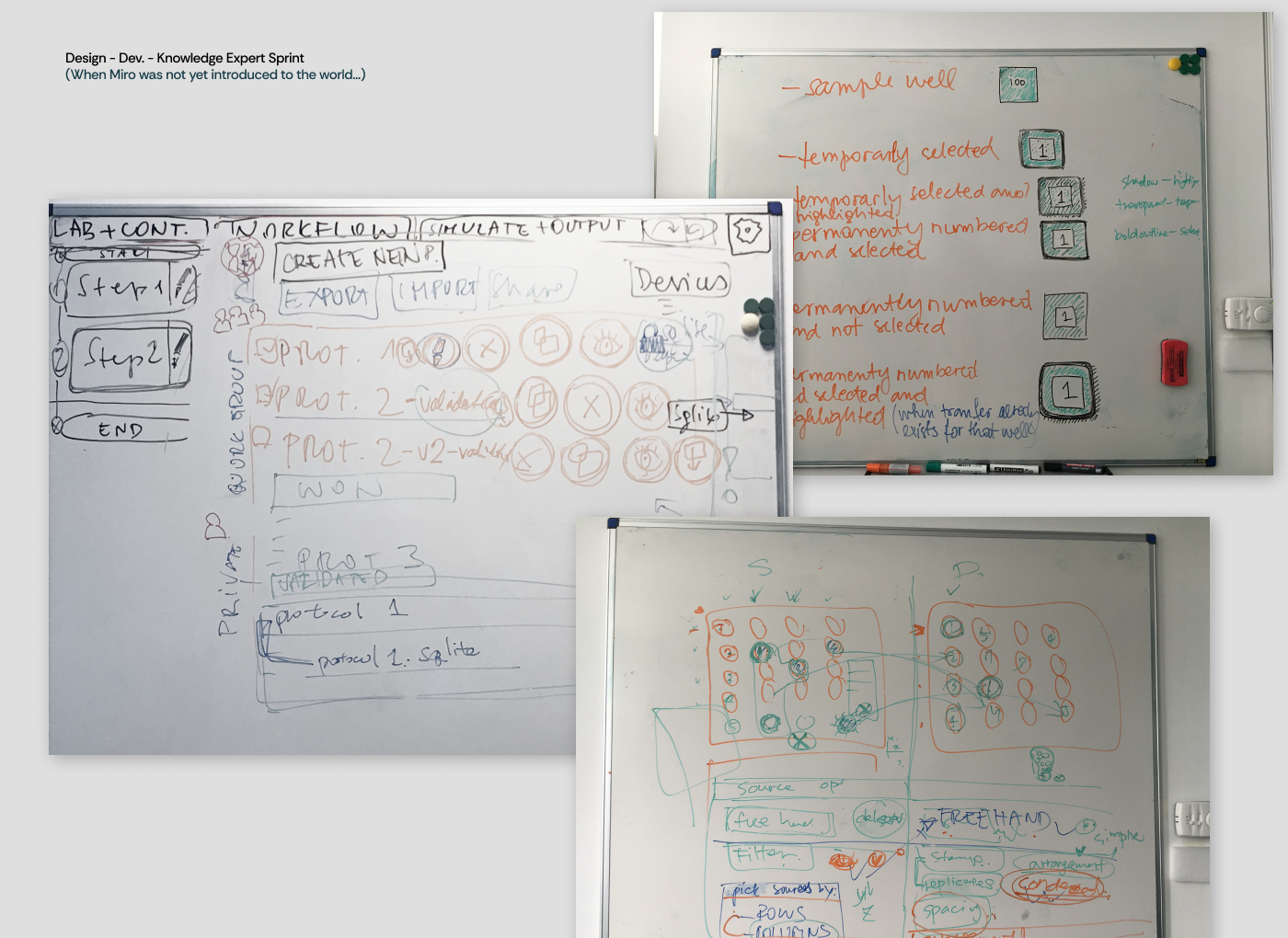
At the time, remote collaboration tools weren’t common, so I relocated to Ljubljana to work on-site with our development partner.
Being in the same space enabled daily iteration, real-time design reviews, and close collaboration with lab professionals, engineers, and domain experts, which were key to shaping the right solution together.
We spent days and nights sketching on whiteboards, testing ideas, debating trade-offs, and aligning on practical compromises. This relentless back-and-forth helped us arrive at a design that was not only user-centered but technically feasible for the next development phase.
- Outcome: POC Design Testing & Delivery
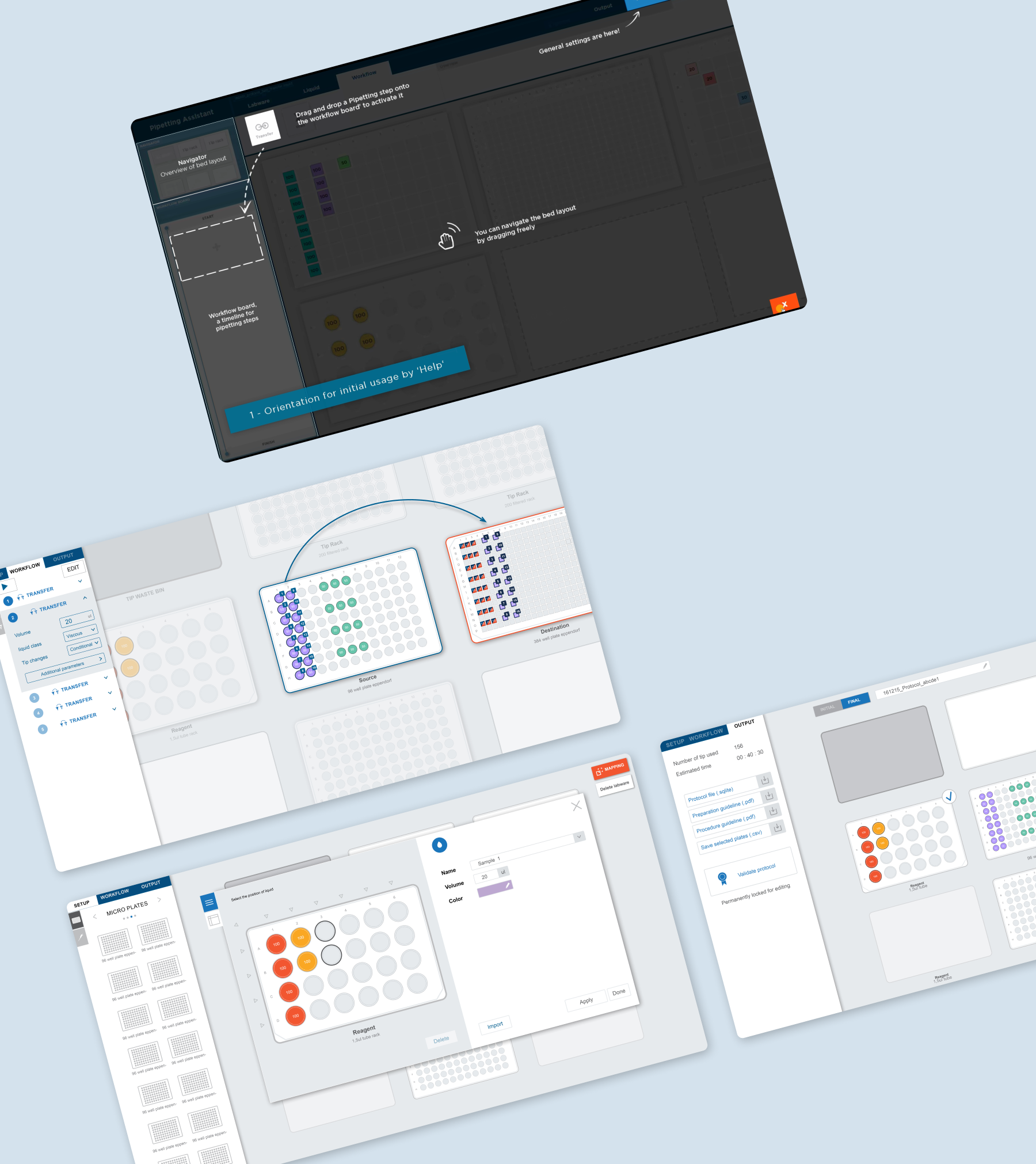
After six months of development and testing, we delivered an interactive prototype tested across three locations (USA, Slovenia, Germany) with eight lab user groups.
⏱️ 30% reduction in protocol setup time
Tested a task including three key steps of creating a simple protocol. Streamlining the setup process saved time and reduced user error. Visual clarity and guided flexibility made even complex workflows feel manageable.
⭐️ Satisfaction improved from 3.7 (Native App) to 6.4 out of 7.0
Compared to 3.7 with Native App, the final prototype saw increased ratings in interface intuitiveness, task completion, and overall engagement.
😎 95% of users felt confident using the tool
Thanks to the tutorial overlay, even users unfamiliar with digital lab tools quickly grasped how to build protocols.
One of the most praised features was the ability to drag and drop samples directly onto a virtual plate — an interaction that felt intuitive, engaging, and close to their real-world workflow.
Reflection
This project didn’t have the conventional happy ending.
Although we delivered a solid prototype, the client’s internal turbulence paused further development, and it never reached the market. Still, I chose to feature this case because of what it taught me, about product strategy, collaboration, and navigating ambiguity.
🧩From Legacy to Cloud
At the time, labs were dominated by outdated native desktop apps, some over 8 years old and never updated. For many users, the idea of creating protocols in a browser felt nearly unimaginable.
This reminded me of an essential truth: users are experts in their problems, not in the solutions. When needs are shaped by outdated tools, it's our role to explore what the current market can’t yet imagine, while anchoring new solutions in familiar experiences and validating through real use.
🧪 Power of being there
There were no Miro boards or Figma links back then. Just Skype, email, and a lot of whiteboards. So I flew to Ljubljana and spent three months. Being onsite allowed us to iterate rapidly, solve problems in real-time, and build genuine team momentum. It taught me that physical presence, especially early in product development, can be effective and transformative.
💬 Navigating Internal Turbulence
Like many consulting projects, this one was hit by shifting priorities and organisational change. At the time, I blamed myself for not keeping the project alive. In hindsight, I realised I was juggling both UX and PM roles, and had no space left to manage client politics and long-term alignment.
My biggest takeaway as a project lead was strategic project delivery needs room to breathe, and so does leadership. Separating delivery from stakeholder orchestration isn't a luxury, it's a necessity.
Note: All data is mock and does not represent real production figures. Confidential details have been removed.
Lab-tech Client Project
Automated Workflow:
Pipetting Assistant
Product Format: Cloud-based Web (POC design)
Project Year: 2015
Client: Confidential
Summary
To build a state-of-the-art protocol builder, we designed a proof of concept that shortens the learning curve and feels intuitive along the building workflow for the lab instrument manufacturing client.
Challenges:
among the pipetting building workflow, by covering key steps: setting up liquids and labware, defining protocol steps, and reviewing the bed layout.
Solution:
A free-canvas interaction UX approach allowed users to explore features freely, with intuitive visual sample setting simulation for approachable and adaptable to individual needs.
Business impact:
⏱️ Protocol setup time was reduced by 30%
⭐️ User satisfaction improved from 3.7 (legacy app) to 6.4 out of 7.0
😎 95% of users reported feeling confident using the tool
Client: Global lab instruments manufacturer
Company: Indeed Innovation GmbH
Team: Myself (UX UI Design & Project Lead), 2 Software Developers, 1 Knowledge experts
Key Responsibilities:
- Project proposal and scoping
- Design strategy & User research
- UI prototyping & user testing
- Client management
- Background & Goal
The client, a U.S.-based manufacturer known for precision lab instruments, aimed to develop a state-of-the-art protocol builder software. The mission was to dramatically reduce the learning curve and streamline the process of pipetting protocol creation, making it intuitive, efficient, and cloud-ready for use across desktop and mobile devices.
“ How can we create state-of-the-art protocol builder software that shortens the learning curve and is as easy to use as possible?
- Getting to know the Lab
A laboratory was a new world to me, and it was essential to understand how this world is operating and who are engaged to this entire workflow and what are the underlying challenges and motivation.
A. Field Research: Environment-Tool-Stakeholder Map
To gain firsthand insight, I spent a full week embedded in a working lab, observing workflows and shadowing scientists, engineers, and supervisors. I mapped the complete user journey, from equipment delivery and onboarding to independent use.
What stood out:
“The legacy native app is highly-regulating the pipetting workflow and not intuitive so needed 7-day technician’s onboarding.”
We identified several key bottlenecks in the protocol creation process prior to operating the pipetting machine:
- Setting up liquids and labware
- Creating workflow steps
- Reviewing the bed layout and settings
These pain points helped define the MVP and shape the design scope and delivery plan. To broaden our perspective, we proposed exploring multiple UX directions through wireframing. This led to defining the high-level software concept and prototyping detailed interactions. The high-fidelity mockups were then tested with users, validated through feedback, and iterated accordingly.
- Wireframing: Two UX Models
To define UX direction, we proposed two concepts with different workflow styles:
A. Linear workflow (Guided workflow)
- A step-by-step guide, structured and easy to follow
- Focusing on each task with a full screen and contextual menus while being able to navigate to the next step.
B. Free-Canvas (Enabling dynamic workflow)
- An open canvas style with drag-and-drop interaction, more flexible, but less prescriptive.
- Allowing users to explore different features and steps which enables full customisation of protocol creation.
✨ Testing Result: B. Free-Canvas Style
Based on user testing, the concept B, the free-canvas style was clearly preferred. Users appreciated it for several reasons:
- It offered more clarity and control, especially when customizing complex experiments.
- The drag-and-drop interaction felt intuitive and even slightly gamified, which made the experience more engaging and increased their motivation to use the software.
“This is one of the first signs that scientific software could embrace more creative, non-linear interaction models.”
- POC design development: Germany <-> Slovenia Collaboration
How could collaboration look like without virtual tools (Miro / Figma)?
At the time, remote collaboration tools weren’t common, so I relocated to Ljubljana to work on-site with our development partner.
Being in the same space enabled daily iteration, real-time design reviews, and close collaboration with lab professionals, engineers, and domain experts, which were key to shaping the right solution together.
We spent days and nights sketching on whiteboards, testing ideas, debating trade-offs, and aligning on practical compromises. This relentless back-and-forth helped us arrive at a design that was not only user-centered but technically feasible for the next development phase.
- Outcome: POC Design Testing & Delivery
After six months of development and testing, we delivered an interactive prototype tested across three locations (USA, Slovenia, Germany) with eight lab user groups.
⏱️ 30% reduction in protocol setup time
Tested a task including three key steps of creating a simple protocol. Streamlining the setup process saved time and reduced user error. Visual clarity and guided flexibility made even complex workflows feel manageable.
⭐️ Satisfaction improved from 3.7 (Native App) to 6.4 out of 7.0
Compared to 3.7 with Native App, the final prototype saw increased ratings in interface intuitiveness, task completion, and overall engagement.
😎 95% of users felt confident using the tool
Thanks to the tutorial overlay, even users unfamiliar with digital lab tools quickly grasped how to build protocols.
One of the most praised features was the ability to drag and drop samples directly onto a virtual plate — an interaction that felt intuitive, engaging, and close to their real-world workflow.
Reflection
This project didn’t have the conventional happy ending.
Although we delivered a solid prototype, the client’s internal turbulence paused further development, and it never reached the market. Still, I chose to feature this case because of what it taught me, about product strategy, collaboration, and navigating ambiguity.
🧩From Legacy to Cloud
At the time, labs were dominated by outdated native desktop apps, some over 8 years old and never updated. For many users, the idea of creating protocols in a browser felt nearly unimaginable.
This reminded me of an essential truth: users are experts in their problems, not in the solutions. When needs are shaped by outdated tools, it's our role to explore what the current market can’t yet imagine, while anchoring new solutions in familiar experiences and validating through real use.
🧪 Power of being there
There were no Miro boards or Figma links back then. Just Skype, email, and a lot of whiteboards. So I flew to Ljubljana and spent three months. Being onsite allowed us to iterate rapidly, solve problems in real-time, and build genuine team momentum. It taught me that physical presence, especially early in product development, can be effective and transformative.
💬 Navigating Internal Turbulence
Like many consulting projects, this one was hit by shifting priorities and organisational change. At the time, I blamed myself for not keeping the project alive. In hindsight, I realised I was juggling both UX and PM roles, and had no space left to manage client politics and long-term alignment.
My biggest takeaway as a project lead was strategic project delivery needs room to breathe, and so does leadership. Separating delivery from stakeholder orchestration isn't a luxury, it's a necessity.

All Rights Reserved

Note: All data is mock and does not represent real production figures. Confidential details have been removed.
Lab-tech Client Project
Automated Workflow:
Pipetting Assistant
Product Format: Cloud-based Web (POC design)
Project Year: 2015
Client: Confidential
Summary
To build a state-of-the-art protocol builder, we designed a proof of concept that shortens the learning curve and feels intuitive along the building workflow for the lab instrument manufacturing client.
Challenges:
among the pipetting building workflow, by covering key steps: setting up liquids and labware, defining protocol steps, and reviewing the bed layout.
Solution:
A free-canvas interaction UX approach allowed users to explore features freely, with intuitive visual sample setting simulation for approachable and adaptable to individual needs.
Business impact:
⏱️ Protocol setup time was reduced by 30%
⭐️ User satisfaction improved from 3.7 (legacy app) to 6.4 out of 7.0
😎 95% of users reported feeling confident using the tool
Client: Global lab instruments manufacturer
Company: Indeed Innovation GmbH
Team: Myself (UX UI Design & Project Lead), 2 Software Developers, 1 Knowledge experts
Key Responsibilities:
- Project proposal and scoping
- Design strategy & User research
- UI prototyping & user testing
- Client management
- Background & Goal
The client, a U.S.-based manufacturer known for precision lab instruments, aimed to develop a state-of-the-art protocol builder software. The mission was to dramatically reduce the learning curve and streamline the process of pipetting protocol creation, making it intuitive, efficient, and cloud-ready for use across desktop and mobile devices.
“ How can we create state-of-the-art protocol builder software that shortens the learning curve and is as easy to use as possible?
- Getting to know the Lab
A laboratory was a new world to me, and it was essential to understand how this world is operating and who are engaged to this entire workflow and what are the underlying challenges and motivation.
A. Field Research: Environment-Tool-Stakeholder Map
To gain firsthand insight, I spent a full week in a working lab, observing workflows and shadowing scientists, engineers, and supervisors. Based on that the complete user journey with stakeholder landscape was defined from equipment delivery and onboarding to independent use.
From the study, what stood out was:
“The legacy native app is highly-regulating the pipetting workflow and not intuitive so needed 7-day technician’s onboarding.”
We identified several key bottlenecks in the protocol creation process prior to operating the pipetting machine:
- Setting up liquids and labware
- Creating workflow steps
- Reviewing the bed layout and settings
These pain points helped define the MVP and shape the design scope and delivery plan. To broaden our perspective, we proposed exploring multiple UX directions through wireframing. This led to defining the high-level software concept and prototyping detailed interactions. The high-fidelity mockups were then tested with users, validated through feedback, and iterated accordingly.
- Wireframing: Two UX Models
To define UX direction, we proposed two concepts with different workflow styles:
A. Linear workflow (Guided workflow)
- A step-by-step guide, structured and easy to follow
- Focusing on each task with a full screen and contextual menus while being able to navigate to the next step.
B. Free-Canvas (Enabling dynamic workflow)
- An open canvas style with drag-and-drop interaction, more flexible, but less prescriptive.
- Allowing users to explore different features and steps which enables full customisation of protocol creation.
✨ Testing Result: B. Free-Canvas Style
Based on user testing, the concept B, the free-canvas style was clearly preferred. Users appreciated it for several reasons:
- It offered more clarity and control, especially when customizing complex experiments.
- The drag-and-drop interaction felt intuitive and even slightly gamified, which made the experience more engaging and increased their motivation to use the software.
“This is one of the first signs that scientific software could embrace more creative, non-linear interaction models.”
- POC design development: Germany ↔️ Slovenia
How could collaboration look like without virtual tools (Miro / Figma)?
At the time, remote collaboration tools weren’t common, so I relocated to Ljubljana to work on-site with our development partner.
Being in the same space enabled daily iteration, real-time design reviews, and close collaboration with lab professionals, engineers, and domain experts, which were key to shaping the right solution together.
We spent days and nights sketching on whiteboards, testing ideas, debating trade-offs, and aligning on practical compromises. This relentless back-and-forth helped us arrive at a design that was not only user-centered but technically feasible for the next development phase.
- Outcome: POC Design Testing & Delivery
After six months of development and testing, we delivered an interactive prototype tested across three locations (USA, Slovenia, Germany) with eight lab user groups.
⏱️ 30% reduction in protocol setup time
Tested a task including three key steps of creating a simple protocol. Streamlining the setup process saved time and reduced user error. Visual clarity and guided flexibility made even complex workflows feel manageable.
⭐️ Satisfaction improved from 3.7 (Native App) to 6.4 out of 7.0
Compared to 3.7 with Native App, the final prototype saw increased ratings in interface intuitiveness, task completion, and overall engagement.
😎 95% of users felt confident using the tool
Thanks to the tutorial overlay, even users unfamiliar with digital lab tools quickly grasped how to build protocols.
One of the most praised features was the ability to drag and drop samples directly onto a virtual plate — an interaction that felt intuitive, engaging, and close to their real-world workflow.
Reflection
This project didn’t have the conventional happy ending.
Although we delivered a solid prototype, the client’s internal turbulence paused further development, and it never reached the market. Still, I chose to feature this case because of what it taught me, about product strategy, collaboration, and navigating ambiguity.
🧩From Legacy to Cloud
At the time, labs were dominated by outdated native desktop apps, some over 8 years old and never updated. For many users, the idea of creating protocols in a browser felt nearly unimaginable.
This reminded me of an essential truth: users are experts in their problems, not in the solutions. When needs are shaped by outdated tools, it's our role to explore what the current market can’t yet imagine, while anchoring new solutions in familiar experiences and validating through real use.
🧪 Power of being there
There were no Miro boards or Figma links back then. Just Skype, email, and a lot of whiteboards. So I flew to Ljubljana and spent three months. Being onsite allowed us to iterate rapidly, solve problems in real-time, and build genuine team momentum. It taught me that physical presence, especially early in product development, can be effective and transformative.
💬 Navigating Internal Turbulence
Like many consulting projects, this one was hit by shifting priorities and organisational change. At the time, I blamed myself for not keeping the project alive. In hindsight, I realised I was juggling both UX and PM roles, and had no space left to manage client politics and long-term alignment.
My biggest takeaway as a project lead was strategic project delivery needs room to breathe, and so does leadership. Separating delivery from stakeholder orchestration isn't a luxury, it's a necessity.
All Rights Reserved