Note: All data is mock and does not represent real production figures. Confidential details have been removed.

INDEED INNOVATION GmbH

Connectivity:
Wellness Lifestyle App Suite

Product Format: Web application (Responsive)

Project Year: 2022 – Present

Business Partner: VW Group Procurement
Summary

I led the end-to-end design of an internal enterprise web application for logistics and procurement teams - from discovery to delivery. Collaborating with FE/BE developers and business partners, we created an intelligent platform, orchestrating legacy and modern data sources into a unified interface for procurement and logistics teams.

  • Project: Supply chain intelligence platform enabling users to track part supply situations and supplier overviews, preventing shortages across VW Group production plants worldwide


  • My Role: Design Lead within an agile product team
  • Key Responsibilities: Design strategy, user research & testing, UI prototyping and design-handshake, and stakeholder alignment

0. Collaboration model

This diagram shows how we structured cross-functional collaboration throughout the project lifecycle — from early research to product delivery. Designers worked closely with product owners, users, developers, and QA at each stage, ensuring feedback loops were continuous and outcomes stayed aligned with both user needs and business goals. Each phase had clear deliverables, making handoffs smooth and iterative work efficient.

  1. Understand the Status Quo

When I joined Volkswagen, I stepped into a high-stakes automotive ecosystem: thirteen brands, hundreds of plants, and a global supply chain.

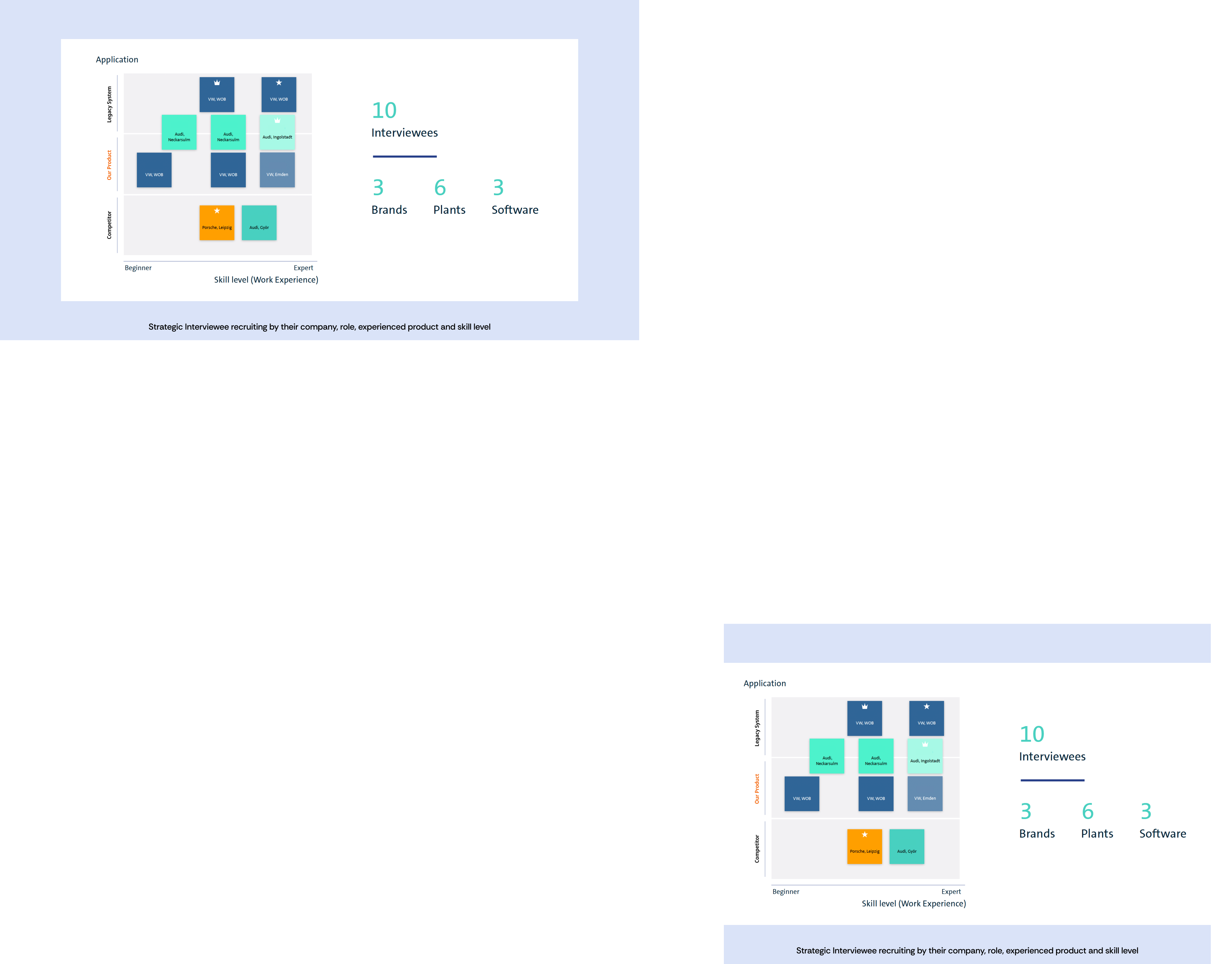
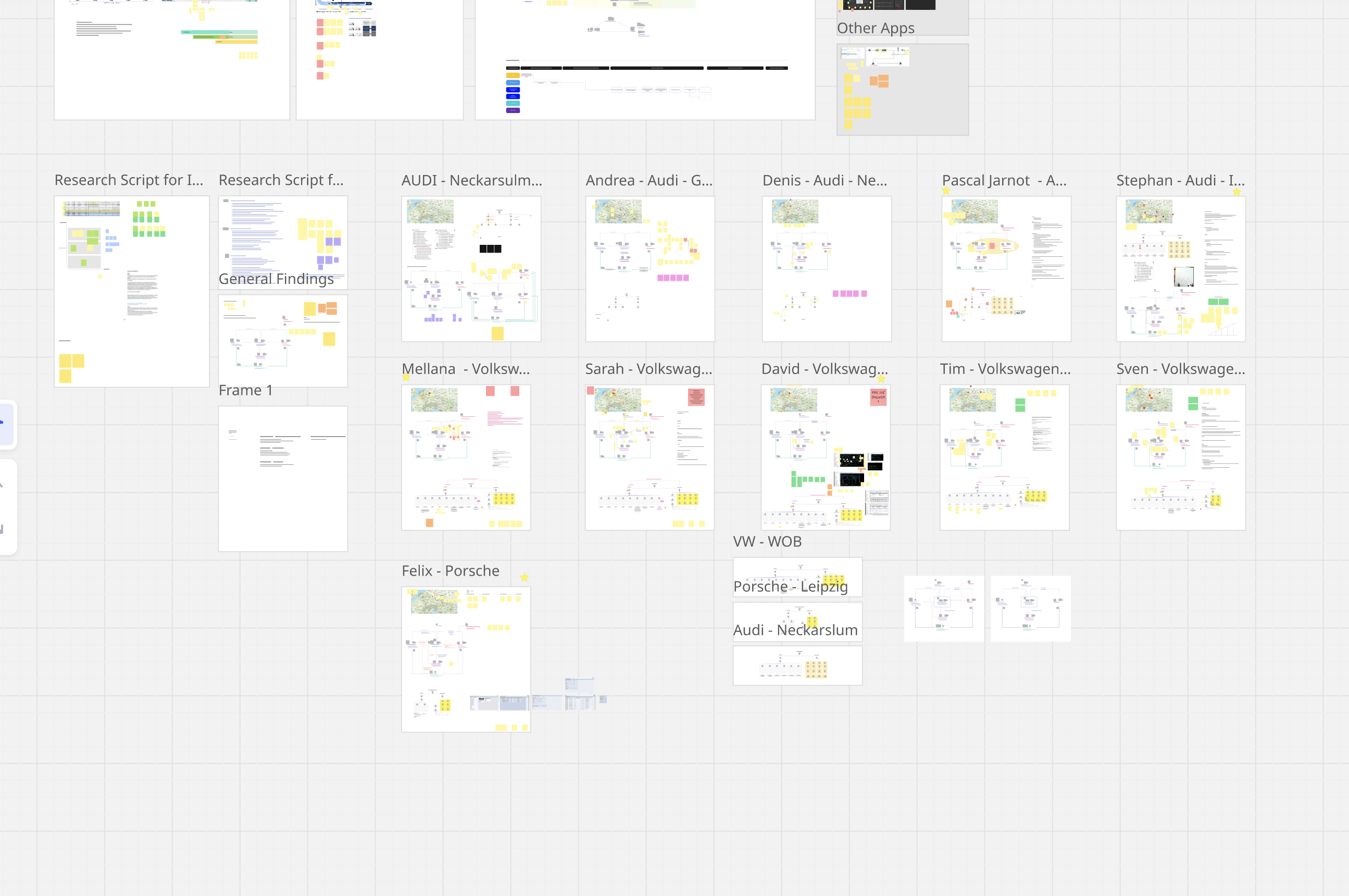
To truly understand the VW business environment and needs of our expert, I went beyond meetings and into the field. We interviewed and shadowed 10 users across roles, brands, and regions to gain insight into their workflows and decision-making. I also facilitated a knowledge-sharing workshop to map the automotive value chain from order to delivery, uncover key systems in use, and identify relevant user roles.

Field research & user workshop

To gather diverse insights, we intentionally brought in 10 users from different roles, brands, plants, and skill levels, each using different tools in their daily work.
We interviewed them and shadowed their workflows over three days. Afterwards, we sat down with them and mapped their work processes, organisational structures, and reporting systems together in Miro.

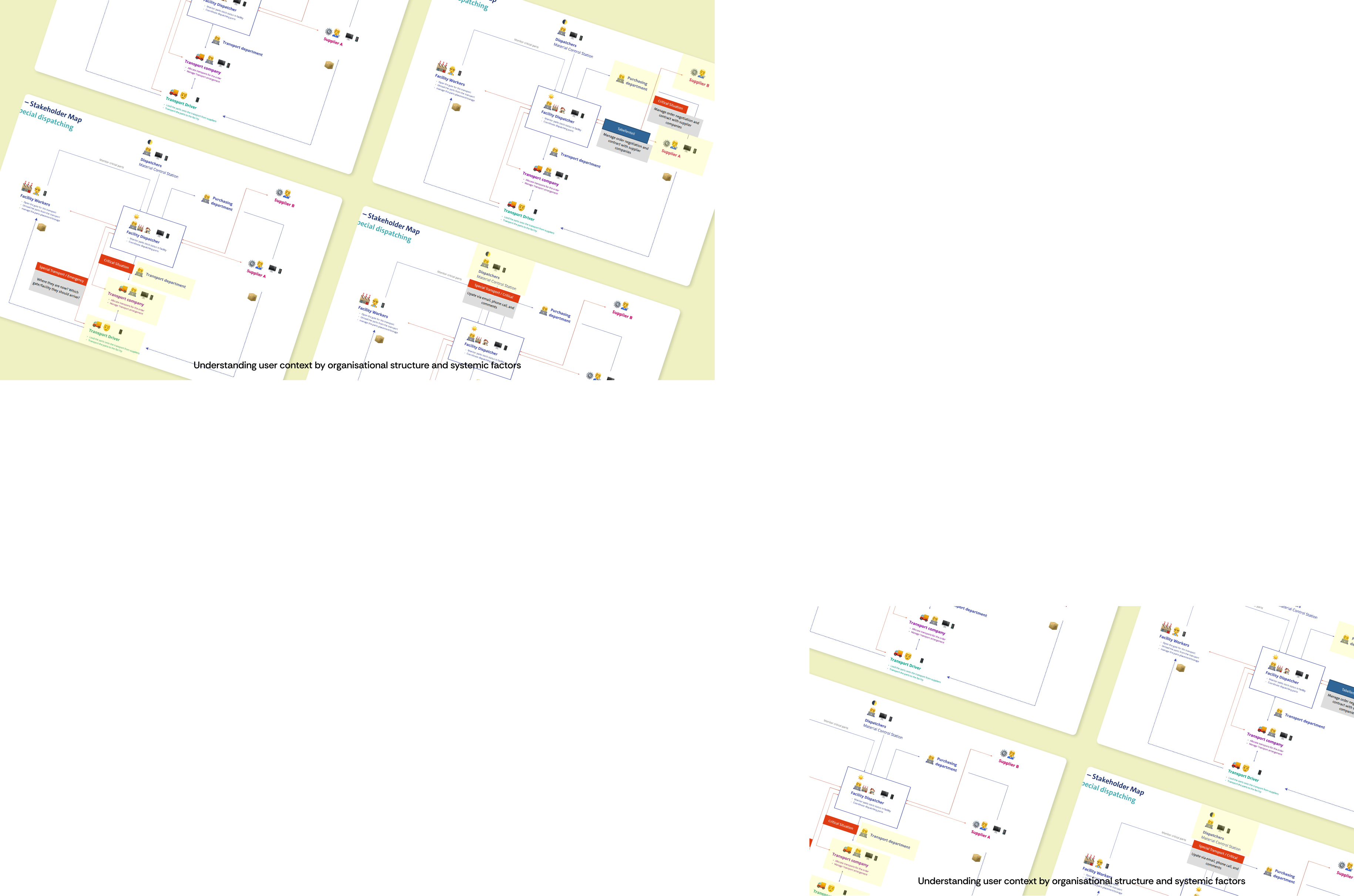
Stakeholder mapping

That study helped us to clarify who is actor, influencer, sponsor and decision maker. These stakeholder mapping activity directed which other applications we need to collaborate in terms of users tool chain
This gave us a clear view of the business landscape, end-to-end processes, constraints, and toolchains, helping us better understand work logic and decision-making.

  1. Discovery & Framing

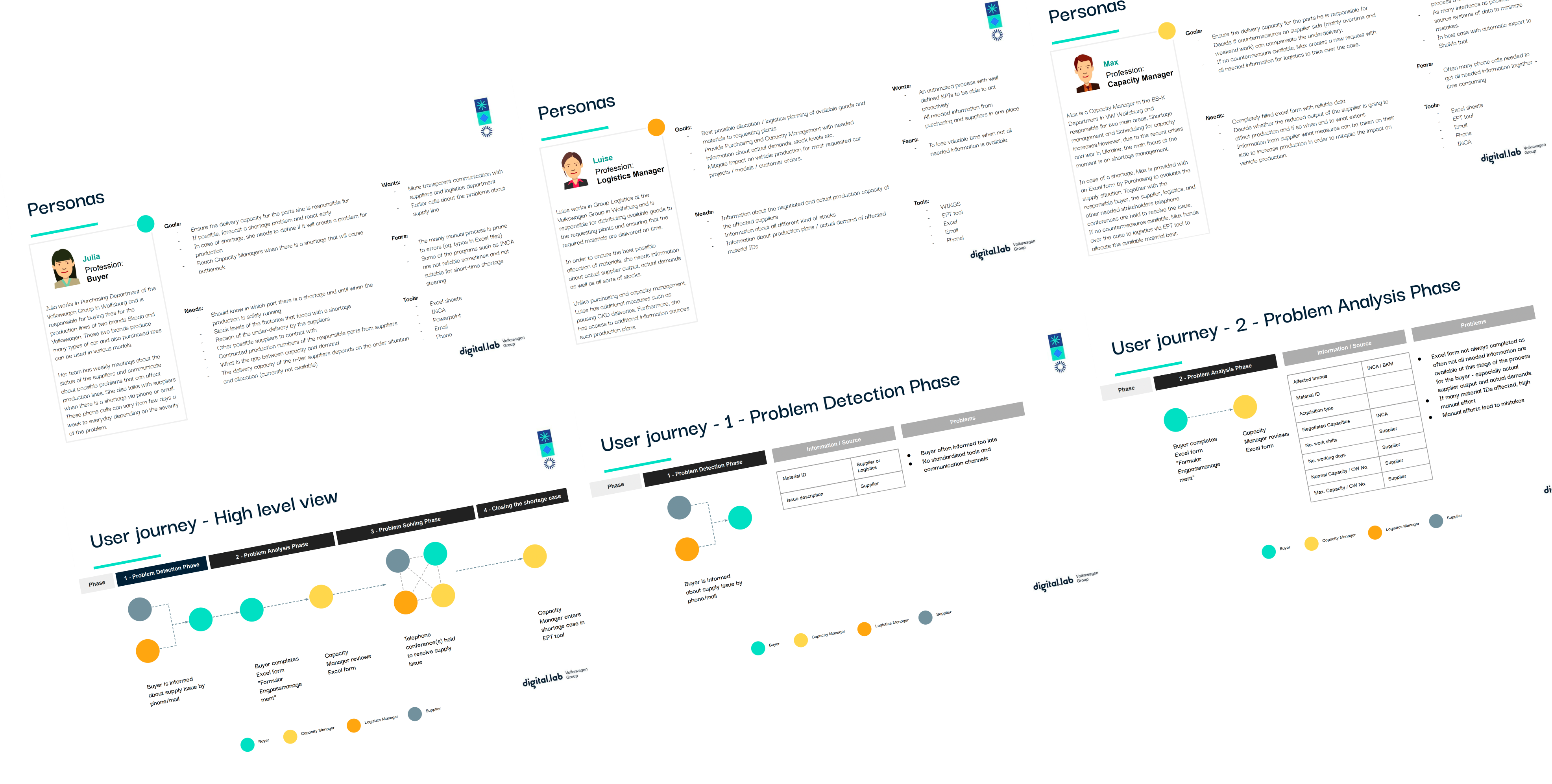
After fully understanding the status quo of user environment, roles, workflows, and product ecosystem, we analysed and defined the product focus with persona, key user journey, and shortage calculation logic. These became the foundational framework for product shaping.

Challenge & Opportunities

We captured the core process of identifying shortage parts and clarified the users' primary goal: to detect shortages based on daily and weekly stock forecasts and quickly understand their root causes.

From there, we identified key challenges and began exploring possible solutions. Through a series of cross-functional workshops and technical research, we surfaced three opportunity areas in high-level with clear potential for impact.

Challenge 1

Cognitive Overload: All information on one page creates distraction and prevents effective shortage identification

Challenge 2

Tool Carnivalism: Disconnected systems for shortage identification, problem solving, and reporting create silos and internal cannibalization

Challenge 3

Supply Chain Blind Spots: Missing external supplier information and tier relations obscure 80% of shortage root causes

Opportunity 1

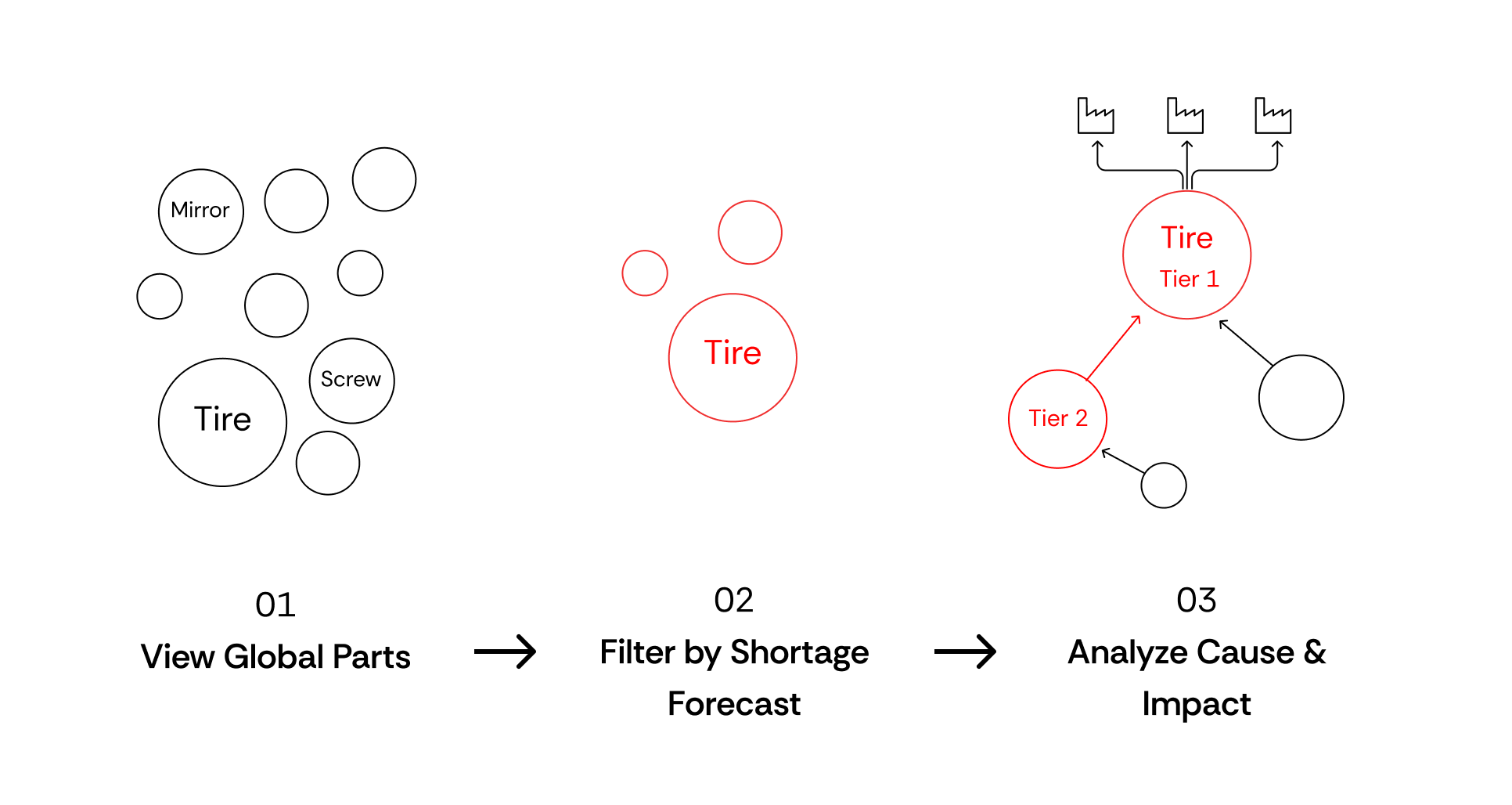
Staged Information Diet: Divide workflow into three digestible pages—Global overview, Part details, and Bottleneck management

Opportunity 2

Ecosystem Orchestration: Provide API bridges to specialized tools instead of building everything, enabling seamless cross-platform workflows

Opportunity 3

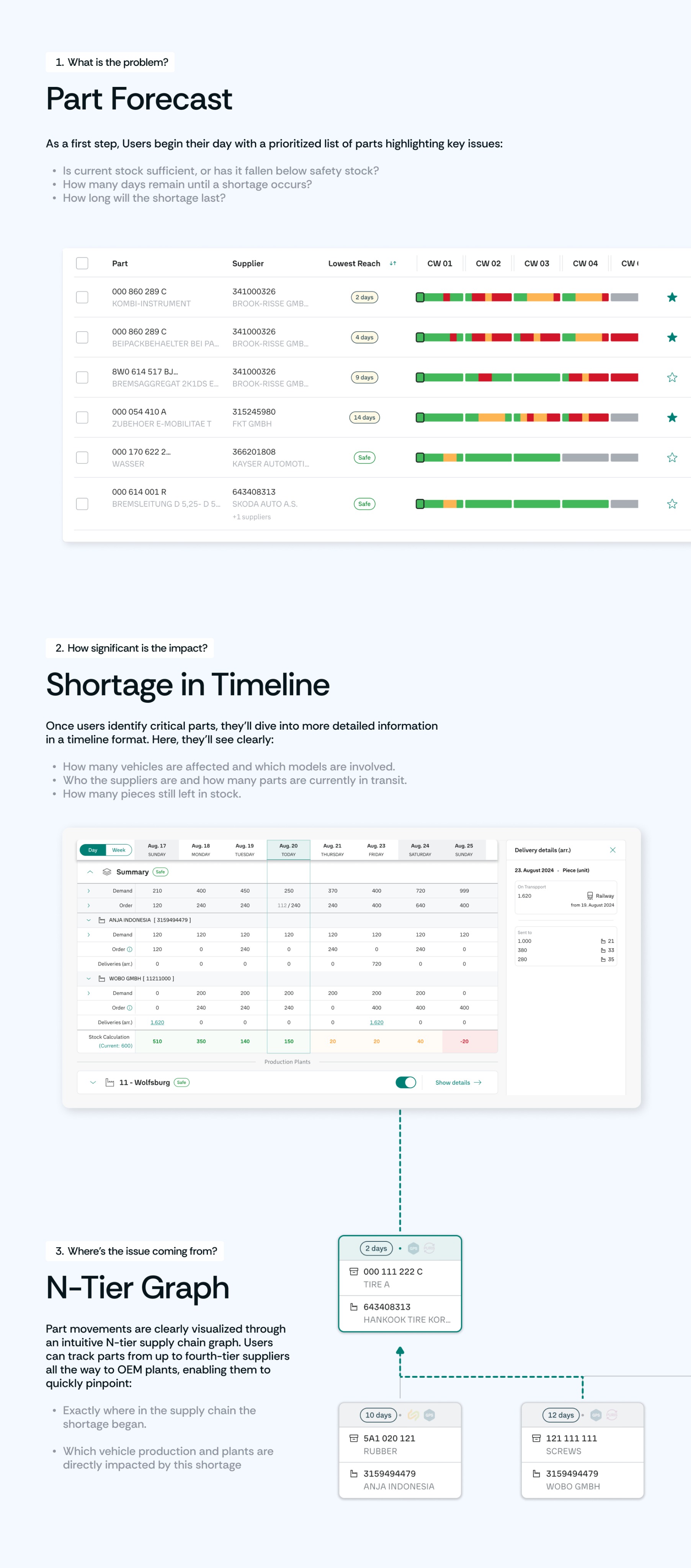
N-tier Graph: Use graph visualization to reveal hidden part-specific supply chain relationships with BOM data

Focus usecase

We defined a clear focus use case within the broader bottleneck management process. We targeted the early stage, identifying part shortages, as our core scenario. This became the foundation and canvas for shaping our product ideas and design direction.

  1. Iterative Creation & Validation:
    UI Solution ↔️ User Testing

When clear product goals and feature ideas were in place, we kicked off the most exciting phase: creation.


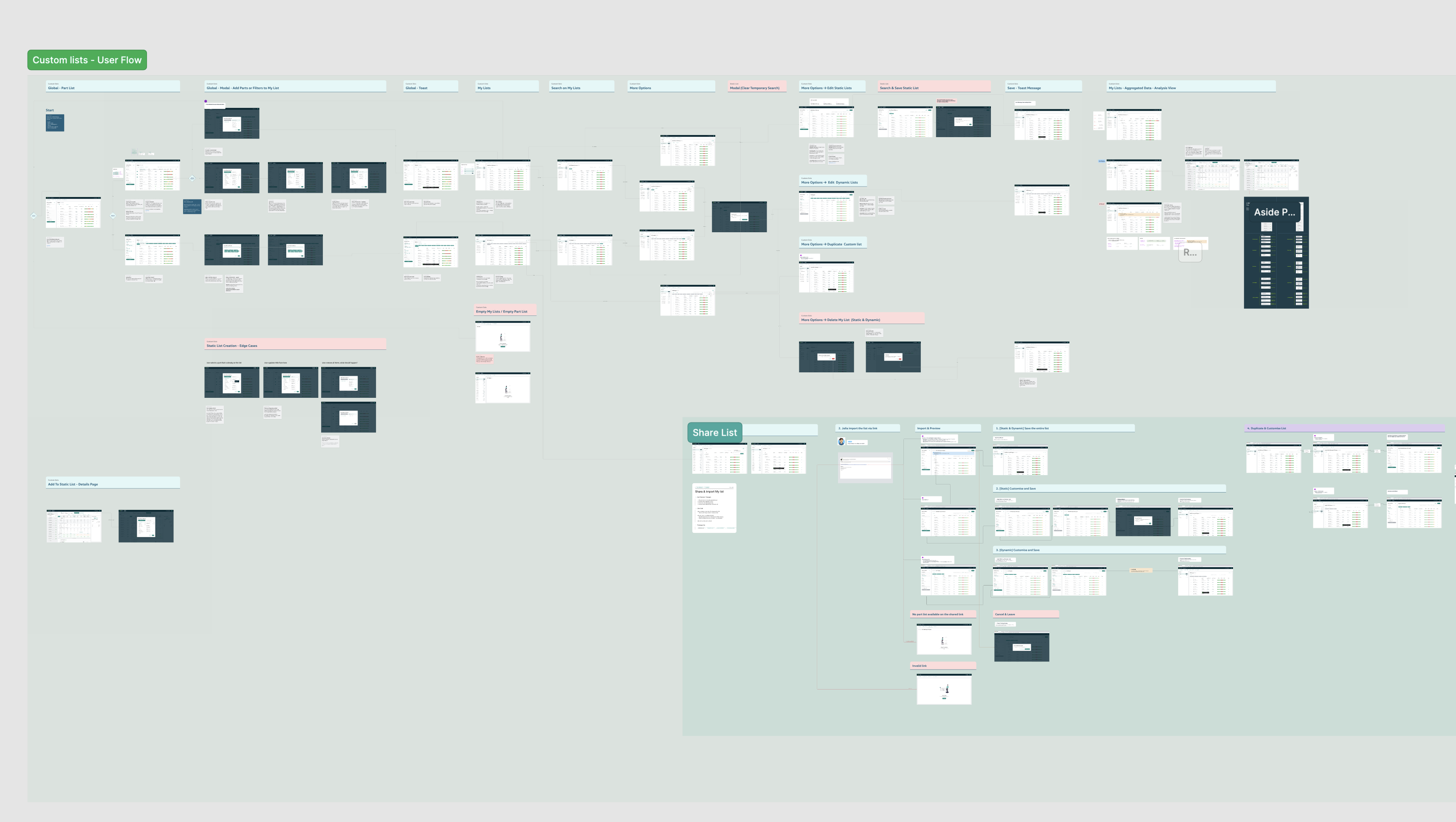
The challenge wasn’t just what to display, but how defining the right information flow, behaviours, and priorities. Once the information architecture and user flows were mapped, I led the team through iterative design cycles:


  1. Define focus flow and key scenario
  2. Sketch quick mockups with the team (design, dev, and PM)
  3. Build high-fidelity prototypes to align with business stakeholders
  4. Refine concepts based on technical and business input
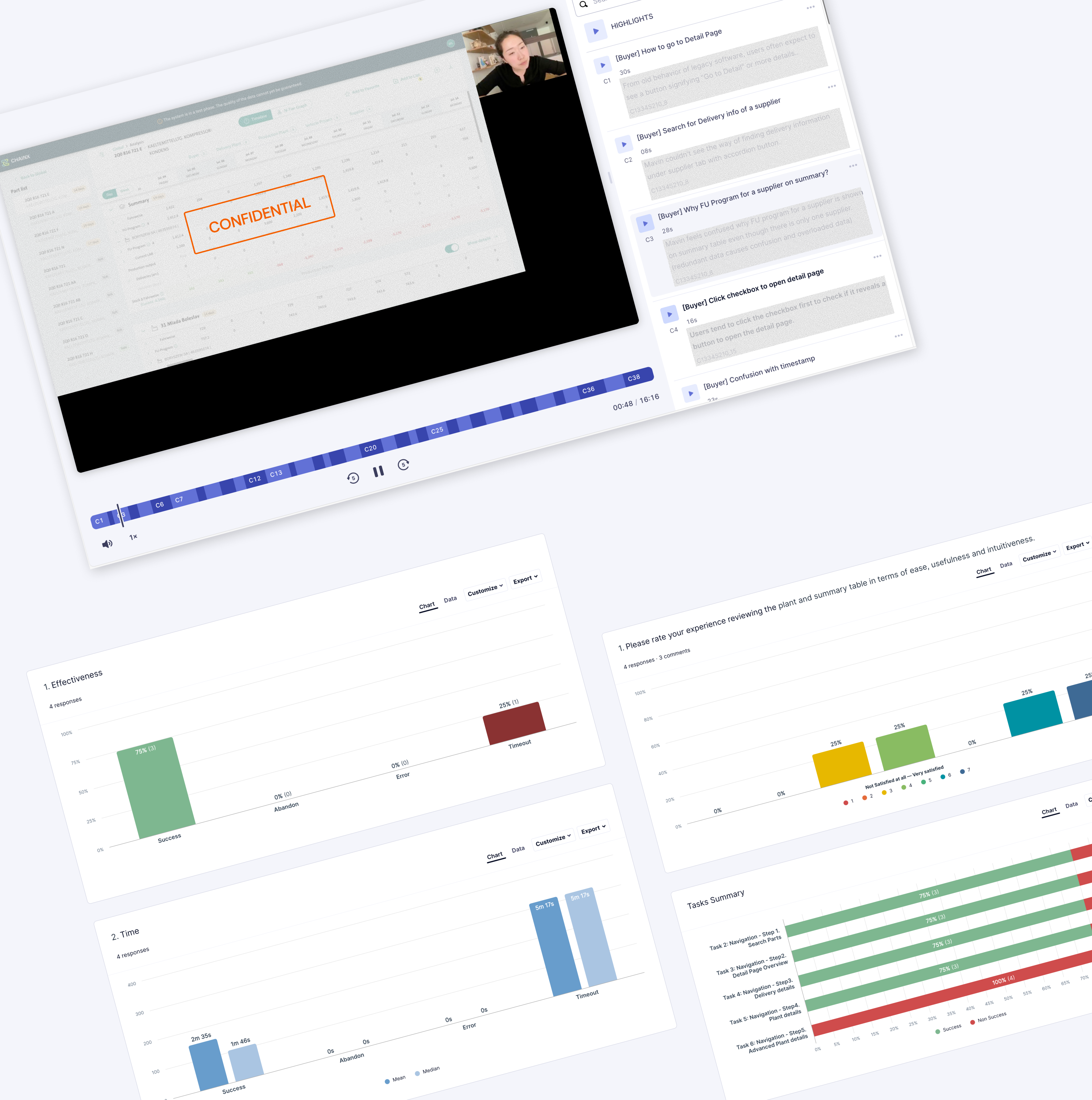
  5. Validate through user testing and behavioural analytics
  6. Iterate designs to address insights and improve usability


  1. Design Hand-shake

In every sprint, I deliver designs validated through user testing and team reviews.

The design handoff process became an evolutionary step for our team. In this phase, I approach developers as my users. Clear, thoughtful annotations and well-defined flows are essential to support their work. Referencing design tokens and shared components proved invaluable, while providing contextual user goals and design intent for each feature helped developers build with clarity and confidence, that supports higher-quality delivery.

Figma → Phrase → Code

In collaboration with the development team, I defined a consistent naming convention. Keys were created and maintained by designers in context, enabling a seamless design-to-development workflow and significantly reducing developer time spent searching for the correct key-value pairs.

  1. The Outcome

After 1.5 years of work, our product went live. After another year in 2024, together with the business team, we measured our business impact and user satisfaction via multiple channel and methods.

Evaluation & Reflection

After 1.5 years of work, our product went live. After another year in 2024, together with the business team, we measured our business impact and user satisfaction via multiple channel and methods.

Business Impact

⏱️ Task completion time dropped from 12 mins 29seconds to 6 seconds for critical flows (e.g. finding Shipment note number)

Stakeholder Impact

👥 8000+ users onboarded across plants of 6 brands (Audi, SEAT, Skania, Porsche, VW, Skoda) with consistently positive adoption feedback

Organisational Impact

📜 As a new standard

The user insights and customer journey we explored and defined have since been adopted by other teams as organizational UX standards.

But more than the metrics, what I'm most proud of is this.
A buyer user tested our product and said,

I didn't think a tool like this could exist here. It feels like it was made by someone who actually understands my day.

That's when I realised we weren't just solving a usability problem but enhancing a fundamental disconnect between how people work and how systems were designed to support them.

This project taught me several important lessons:

🧩 “I need all the data” doesn’t mean “show me everything at once.”Users often ask for full visibility, but what they truly need is the right information, at the right time, for the task at hand. Structuring data contextually across steps allowed us to strike a balance between completeness and usability.

🧪 User testing must stay dynamic.
We had a long-standing test group, and over time, some users became too familiar with the product - overlooking friction points. Regularly onboarding fresh testers with no prior experience helped us catch issues that habitual users missed.

💬 Communication. Communication. Communication.
In enterprise design, collaboration is everything. Technical and business constraints, from legacy process to compliance policies. often limit what we can change. That’s why I treat open communication as a core part of design. Proactively aligning with developers and business teams helped surface constraints early, fostered shared ownership, and eliminated unnecessary blockers before they became issues.

All Rights Reserved

Note: All data is mock and does not represent real production figures. Confidential details have been removed.

INDEED INNOVATION GmbH

Connectivity: Wellness Lifestyle App Suite

Product Format: Web application (Responsive)

Project Year: 2022 – Present

Business Partner: VW Group Procurement
Summary

I led the end-to-end design of an internal enterprise web application for logistics and procurement teams - from discovery to delivery. Collaborating with FE/BE developers and business partners, we created an intelligent platform, orchestrating legacy and modern data sources into a unified interface for procurement and logistics teams.

  • Project: Supply chain intelligence platform enabling users to track part supply situations and supplier overviews, preventing shortages across VW Group production plants worldwide


  • My Role: Design Lead within an agile product team
  • Key Responsibilities: Design strategy, user research & testing, UI prototyping and design-handshake, and stakeholder alignment

0. Collaboration model

This diagram shows how we structured cross-functional collaboration throughout the project lifecycle — from early research to product delivery. Designers worked closely with product owners, users, developers, and QA at each stage, ensuring feedback loops were continuous and outcomes stayed aligned with both user needs and business goals. Each phase had clear deliverables, making handoffs smooth and iterative work efficient.

  1. Understand the Status Quo

When I joined Volkswagen, I stepped into a high-stakes automotive ecosystem: thirteen brands, hundreds of plants, and a global supply chain.

To truly understand the VW business environment and needs of our expert, I went beyond meetings and into the field. We interviewed and shadowed 10 users across roles, brands, and regions to gain insight into their workflows and decision-making. I also facilitated a knowledge-sharing workshop to map the automotive value chain from order to delivery, uncover key systems in use, and identify relevant user roles.

Field research & user workshop

To gather diverse insights, we intentionally brought in 10 users from different roles, brands, plants, and skill levels, each using different tools in their daily work.
We interviewed them and shadowed their workflows over three days. Afterwards, we sat down with them and mapped their work processes, organisational structures, and reporting systems together in Miro.
Stakeholder mapping
By understanding the environment, stakeholder landscape, users, and their tools, we uncovered critical insights:
who the actors and influencers are, which workflows still relied on manual effort, what information was essential to identify bottlenecks, and how procurement and logistics processes could be better orchestrated.

  1. Discovery & Framing

After fully understanding the status quo of user environment, roles, workflows, and product ecosystem, we analysed and defined the product focus with persona, key user journey, and shortage calculation logic. These became the foundational framework for product shaping.

Challenge & Opportunities

We captured the core process of identifying shortage parts and clarified the users' primary goal: to detect shortages based on daily and weekly stock forecasts and quickly understand their root causes.

From there, we identified key challenges and began exploring possible solutions. Through a series of cross-functional workshops and technical research, we surfaced three opportunity areas in high-level with clear potential for impact.

Challenge 1

Cognitive Overload: All information on one page creates distraction and prevents effective shortage identification

Challenge 2

Tool Carnivalism: Disconnected systems for shortage identification, problem solving, and reporting create silos and internal cannibalization

Challenge 3

Supply Chain Blind Spots: Missing external supplier information and tier relations obscure 80% of shortage root causes

Opportunity 1

Staged Information Diet: Divide workflow into three digestible pages—Global overview, Part details, and Bottleneck management

Opportunity 2

Ecosystem Orchestration: Provide API bridges to specialized tools instead of building everything, enabling seamless cross-platform workflows

Opportunity 3

N-tier Graph: Use graph visualization to reveal hidden part-specific supply chain relationships with BOM data

Focus usecase
We defined a clear focus use case within the broader bottleneck management process. We targeted the early stage, identifying part shortages, as our core scenario. This became the foundation and canvas for shaping our product ideas and design direction.

  1. Iterative Creation & Validation:
    UI Solution ↔️ User Testing

When clear product goals and feature ideas were in place, we kicked off the most exciting phase: creation.


The challenge wasn’t just what to display, but how defining the right information flow, behaviours, and priorities. Once the information architecture and user flows were mapped, I led the team through iterative design cycles:


  1. Define focus flow and key scenario
  2. Sketch quick mockups with the team (design, dev, and PM)
  3. Build high-fidelity prototypes to align with business stakeholders
  4. Refine concepts based on technical and business input
  5. Validate through user testing and behavioural analytics
  6. Iterate designs to address insights and improve usability


  1. Design Hand-shake

In every sprint, I deliver designs validated through user testing and team reviews.

The design handoff process became an evolutionary step for our team. In this phase, I approach developers as my users. Clear, thoughtful annotations and well-defined flows are essential to support their work. Referencing design tokens and shared components proved invaluable, while providing contextual user goals and design intent for each feature helped developers build with clarity and confidence, that supports higher-quality delivery.

Figma → Phrase → Code

In collaboration with the development team, I defined a consistent naming convention. Keys were created and maintained by designers in context, enabling a seamless design-to-development workflow and significantly reducing developer time spent searching for the correct key-value pairs.
  1. The Outcome

Rather than aiming for a large-scale rollout, we started small - focusing on core functionality with immediate value. We initially deployed the software to a whitelist group of 50 VW brand employees and continuously validated our beta version through their feedback.

In the technical point of view, one of the major challenges was the lack of timely integration with external supply data. To move forward, we leveraged internal data, including demand, orders, deliveries, and stock, to calculate a reliable shortage forecast. This allowed us to launch the product while still delivering the essential value our users needed most.

Evaluation & Reflection

After 1.5 years of development, our product went live and has gradually onboarded over 8,000 users across six VW Group brands.

Usability testing and feedback from business partners suggested that our solution performed well in comparison to external alternatives, with especially shorter task times as one of the key improvements.

Our user research approach in the logistics and procurement domain was also positively received and later referenced by other internal product teams.

Business Impact

⏱️ Task completion time dropped from 12 mins 29seconds to 6 seconds for critical flows (e.g. finding Shipment note number)

Stakeholder Impact

👥 8000+ users onboarded across plants of 6 brands (Audi, SEAT, Skania, Porsche, VW, Skoda) with consistently positive adoption feedback

Organisational Impact

📜 As a new standard

The user insights and customer journey we explored and defined have since been adopted by other teams as organizational UX standards.

But more than the metrics, what I'm most proud of is this.
A buyer user tested our product and said,

I didn't think a tool like this could exist here. It feels like it was made by someone who actually understands my day.

That's when I realised we weren't just solving a usability problem but enhancing a fundamental disconnect between how people work and how systems were designed to support them.

This project taught me several important lessons:

🧩 “I need all the data” doesn’t mean “show me everything at once.”Users often ask for full visibility, but what they truly need is the right information, at the right time, for the task at hand. Structuring data contextually across steps allowed us to strike a balance between completeness and usability.

🧪 User testing must stay dynamic.
We had a long-standing test group, and over time, some users became too familiar with the product - overlooking friction points. Regularly onboarding fresh testers with no prior experience helped us catch issues that habitual users missed.

💬 Communication. Communication. Communication.
In enterprise design, collaboration is everything. Technical and business constraints, from legacy process to compliance policies. often limit what we can change. That’s why I treat open communication as a core part of design. Proactively aligning with developers and business teams helped surface constraints early, fostered shared ownership, and eliminated unnecessary blockers before they became issues.

All Rights Reserved